THE KHMER EMPIRE Tee
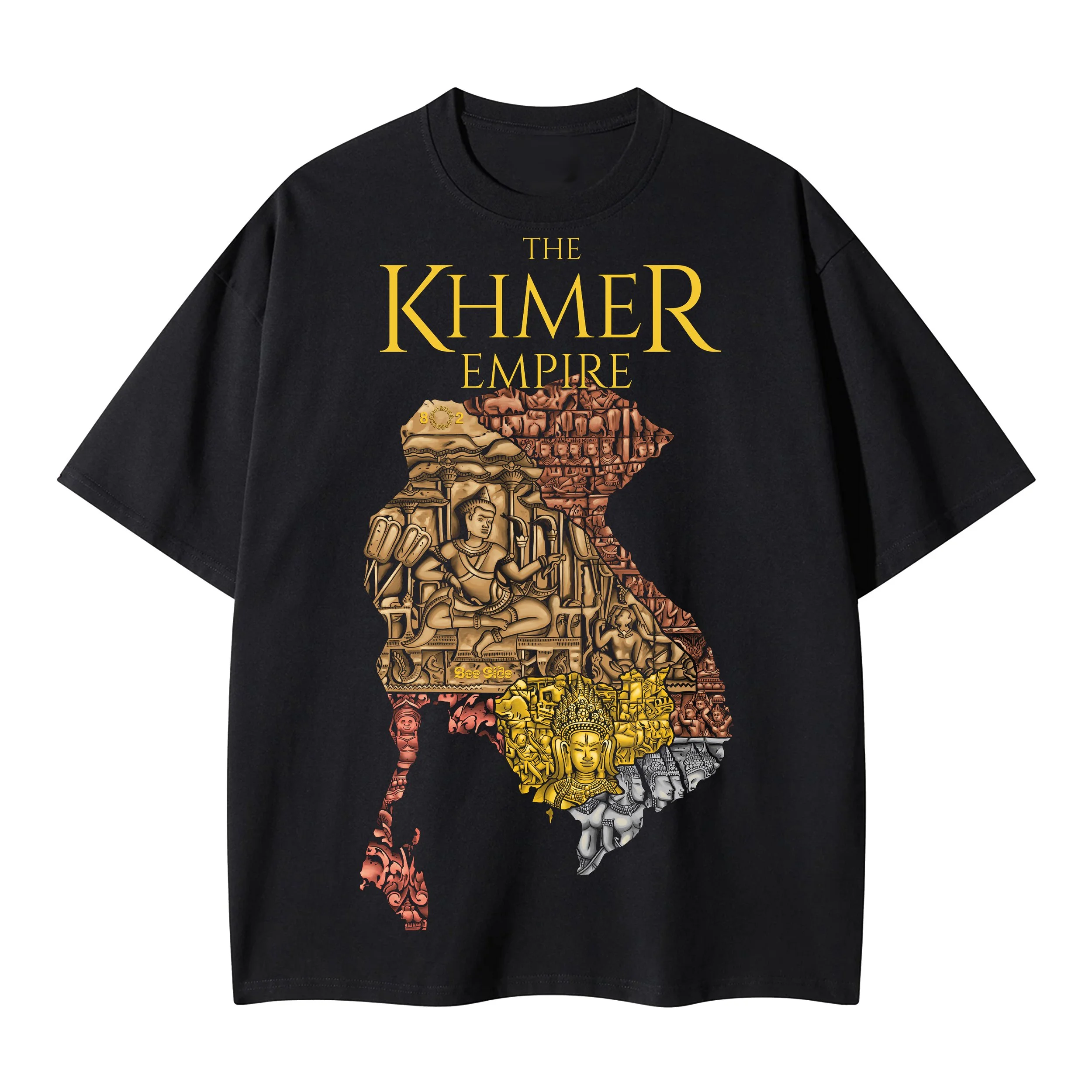
THE KHMER EMPIRE Tee
Built from 100% dual-yarn cotton, this heavyweight tee is made to handle everyday wear without sacrificing comfort. A custom frosted wash delivers a worn-in, vintage look with unique character in every piece, while the premium dye process helps keep the color rich over time. Finished with a relaxed oversized fit.
Hand wash
Iron - medium temperature
Do not bleach
Do not dry clean
Line dry
This design requires special processing. Please allow 7–14 business days for domestic shipping and 4–6 weeks for international shipping
THE KHMER EMPIRE
Our KHMER Legacy carved in Stone. A Motherland Carried in Our Blood.
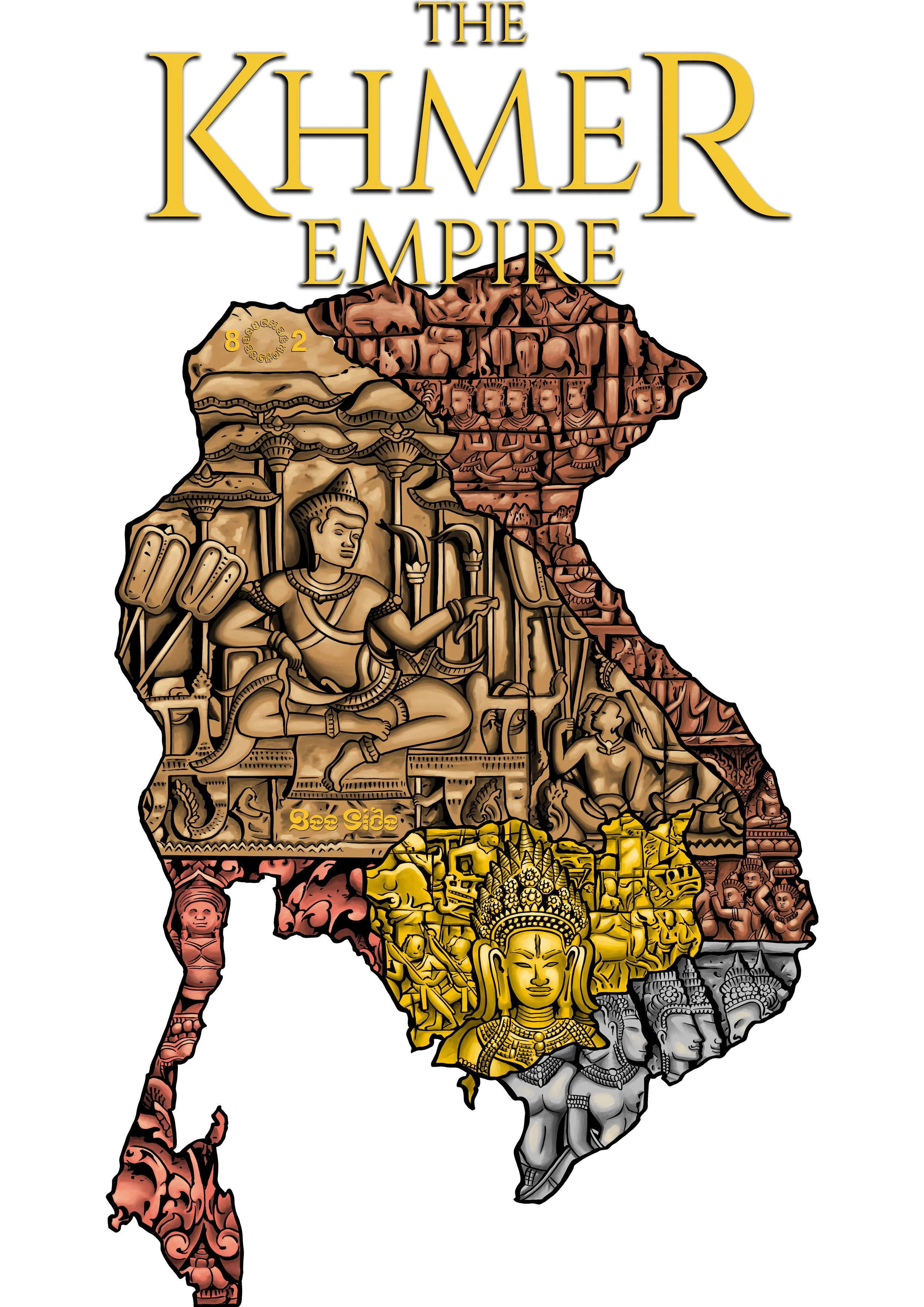
This design is more than a map. It is a visual remembrance of where we came from and a tribute to OUR civilization, OUR culture, and OUR people who shaped the KHMER world. At its center is the image of KHMER KING SURYAVARMAN II, whose stone carved likeness is the largest and most prominent element of the composition. He represents one of the most powerful periods of the ANGKORIAN era and stands as a symbol of OUR KHMER strength, leadership, vision, determination, and ambition.
KHMER KING SURYAVARMAN II ruled during the early twelfth century, at a time when the THE KHMER EMPIRE was already a major power house in mainland Southeast Asia. During his reign, he strengthened royal authority and extended KHMER military and political influence across a vast region. OUR KHMER power reached into territories that are now parts of Laos, and Vietnam, while his campaigns demonstrated the ability of the KHMER state to organize and project military power over great distances. His reign also gave rise to one of the greatest architectural achievements in human history, ANGKOR WAT, a monument that remains one of the most enduring symbols of OUR KHMER civilization.
KHMER KING SURYAVARMAN II is often remembered as THE KHMER WARRIOR KING, but his legacy represents more than warfare. His power depended upon organization, leadership, administration, diplomacy, military strength, and the ability to mobilize enormous human and material resources. The construction of ANGKOR WAT itself reflects the extraordinary organization and resources of the civilization under his rule. Millions of stones had to be quarried, transported, shaped, and assembled by highly skilled craftsmen, while architects, engineers, laborers, religious leaders, and administrators worked together on a monumental scale. ANGKOR WAT became not only a place of worship, but also a powerful expression of royal authority, religious devotion, artistic achievement, and OUR KHMER identity.
At the heart of the design is KHMER QUEEN INDRADEVI, represented in gold. The choice of gold is not simply a reference to royalty. It represents OUR Motherland, OUR Sovannaphum, THE GOLDEN LAND. She stands as a symbolic MOTHER and an embodiment of OUR HOMELAND that gave birth to OUR KHMER civilization, OUR KHMER culture, OUR KHMER language, OUR KHMER traditions, and generations of KHMER people. Where KHMER KING SURYAVARMAN II represents the strength and leadership of the empire, the gold represents the heart, spirit, and enduring connection to the MOTHERLAND. It represents something that cannot be measured by borders: the enduring spirit of OUR KHMER people.
Surrounding the central figures are the stories left behind by OUR KHMER ancestors. Temples, sculptures, kings, queens, warriors, artists, builders, and ordinary people are brought together to represent the many generations that contributed to the OUR KHMER civilization. The different colors represent different chapters of OUR inheritance, while their connection within a single composition reflects the idea that although history contains many chapters, OUR roots remain connected. The stone represents what endures, the map represents the reach of the OUR historical KHMER world, the KHMER KING represents strength and leadership, and the gold represents the OUR MOTHERLAND and OUR cultural KHMER spirit that continues through generations.
Above it all stands the name THE KHMER EMPIRE, not as a call to recreate the past, but as an invitation to remember it, understand it, and carry its wisdom forward. THE KHMER EMPIRE belongs to OUR history, and OUR heritage created by those generations continues to live through OUR KHMER people, KHMER traditions, KHMER language, KHMER art, KHMER architecture, and KHMER cultural memory that remain today.
For the new generation of KHMER youth, this image carries a simple message. Know where you come from. Know what yOUR ancestors created. Know OUR KHMER culture you inherited, and understand the sacrifices, achievements, and generations of knowledge that came before you. History is not simply something that happened long ago. It is part of the story that explains who we are today.
We do not look backward because we are trapped in the past. We look backward so that we can understand who we are as we move forward. THE KHMER EMPIRE may belong to history, but the heritage belongs to us. The land is our MOTHERLAND. The GOLD is our SOVANNAPHUM. The stone is a reminder of what OUR KHMER ancestors left behind. The legacy is OUR inheritance, and the future is OURS to build.